
Why Helrift’s progression bands bring better opportunities closer to greater PvP risk, and how that guides the balance work.
What the playtest showed
There’s nothing quite like letting players into your game to find out what you’ve actually built. Some things worked well in the playtest. Others made a lot more sense in my head. The Balancing Act follows what I’m changing after watching people play and hearing their feedback. Whether you’ve played Helbreath for years or you’re new to this kind of game, I want to show you how that work makes the journey into Helrift’s conflicts worth taking.
I also want to show some of the work behind it. Building an MMO solo gives you plenty of opportunities to change one thing and discover three other things waving for attention. A recipe can change where people gather, which monsters they hunt and what they trade. Following those connections has been one of the most interesting parts of this pass, so I’m taking you through the decisions as well as the results.
All roads lead to conflict
This is the bit I keep coming back to. Fishing, mining, gathering and crafting should give you reasons to venture into places where other players become part of the risk. Better rewards need to pull activity towards contested territory. I can polish each system as much as I like, but if the safest routine is also the most rewarding, I’ve given everyone a very good reason to stay home.
The route there needs to be fair. Players need useful equipment and understandable opportunities before they are asked to take bigger risks. Fairness doesn’t mean everyone has identical gear or wins every fight. It means becoming able to participate shouldn’t depend on finding a shortcut or completing every crafting profession.
What a band actually means
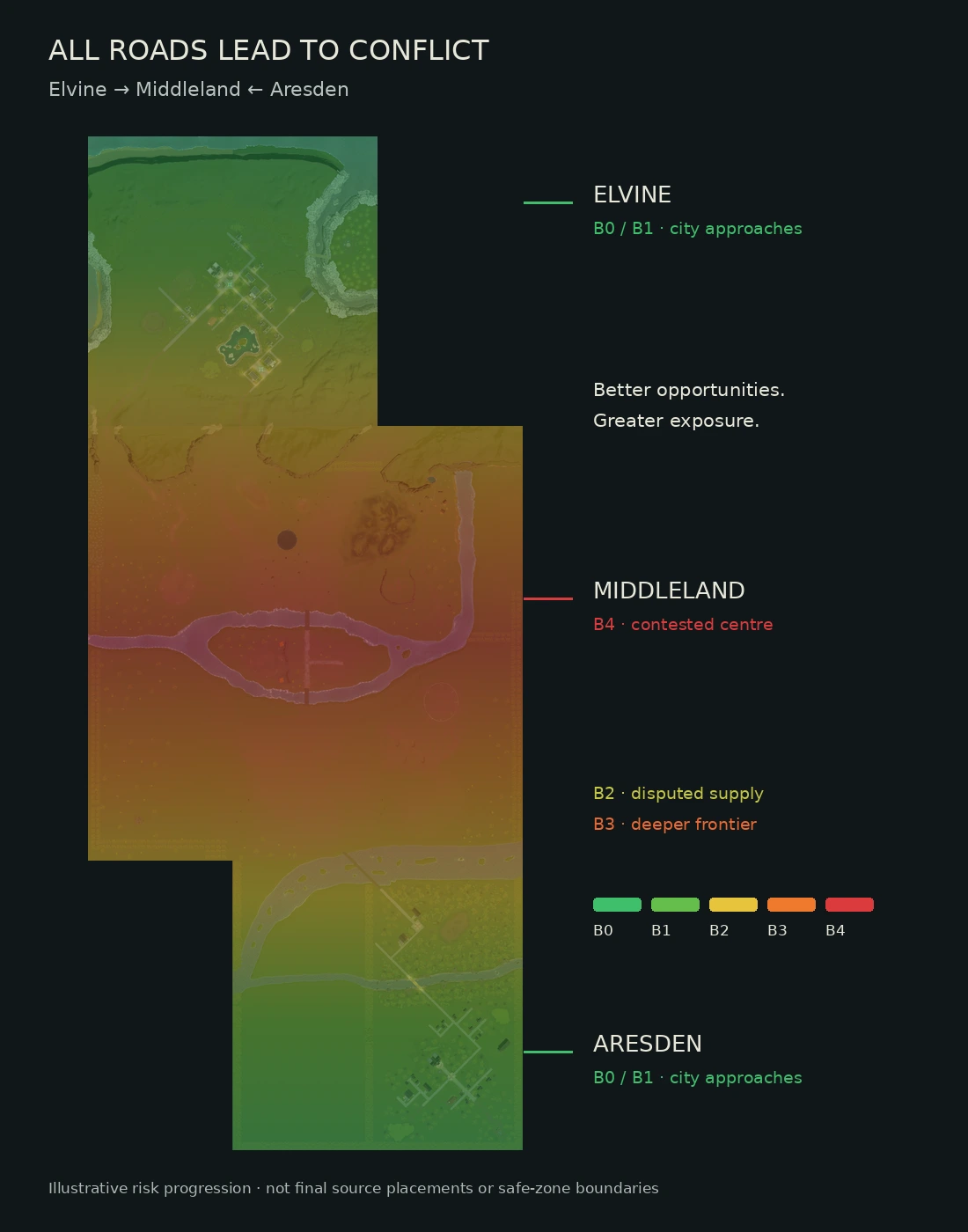
We use B0 through B4 to describe access risk and scarcity. B0 and B1 support abundant, lower-risk materials and entry equipment. B2 introduces disputed supply, B3 takes the route deeper into the frontier, and B4 covers exceptionally scarce apex opportunities. These are design categories; a level number alone cannot tell us how risky a source is.
Higher bands move the valuable supply closer to high-risk PvP areas. The question is more than whether a monster is hard to kill. Can rival players reach the same location? How exposed is the journey? Can an equivalent material be collected somewhere protected? A dangerous-looking monster in a safe area can undermine the intended route. Looking intimidating isn’t quite enough; the commute matters too.
Follow the whole route
An item’s band depends on the least risky valid way of obtaining it. If an advanced recipe needs a contested herb, but an alternative ingredient comes from a protected source, that recipe has a safer route. Asking for another hundred herbs just makes the safe route longer. It doesn’t fix the shortcut.
The same check applies to monster drops, fishing pools, vendors and quests. Trade is welcome: a crafter can buy a material from someone who took the risk. The important part is that the material entered the economy through the intended source. Not every player has to personally do every activity.
Turning the idea into development work
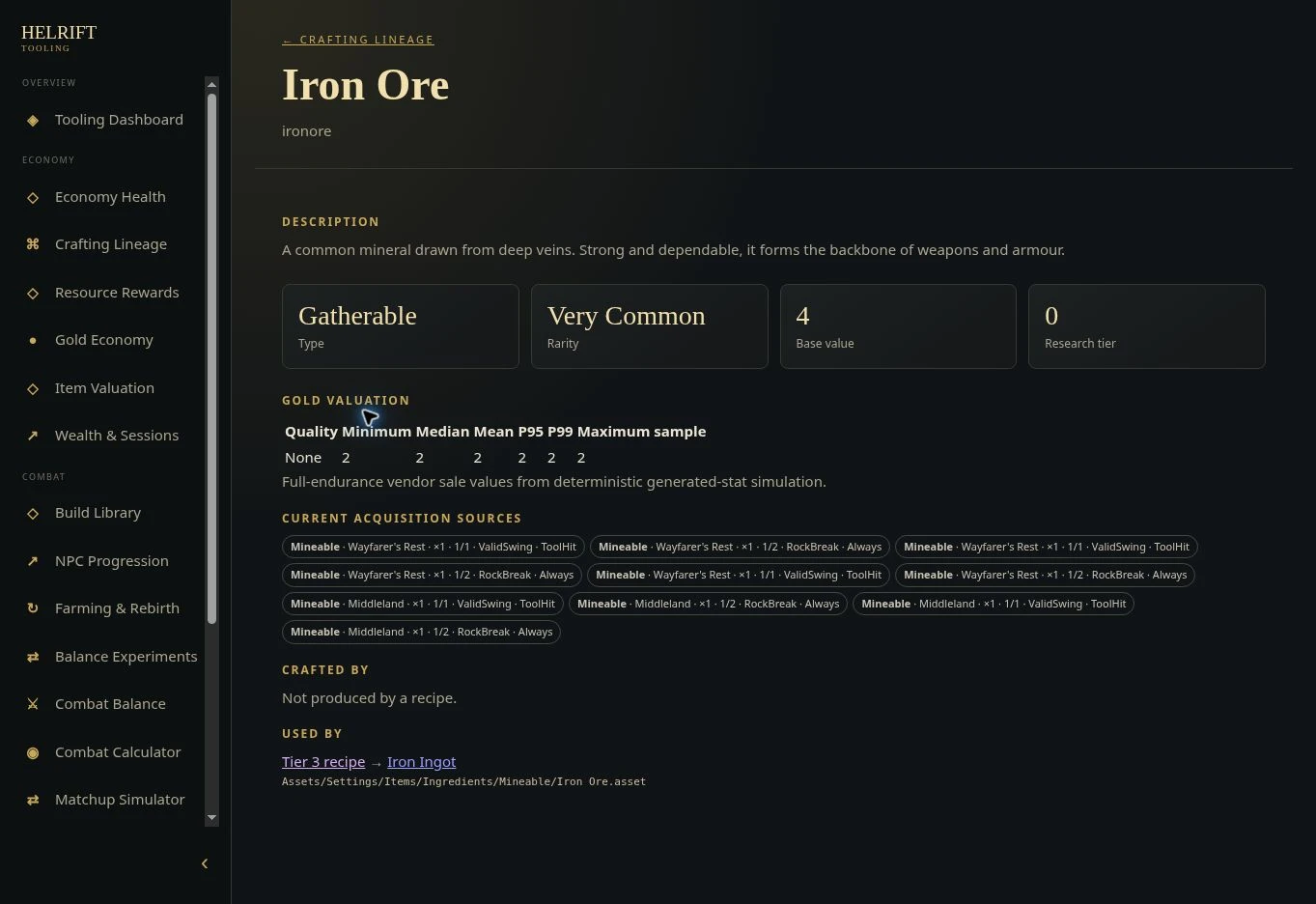
I’ve been using the documentation and tooling together to review those connections. The design states the intended role; the extracted game data helps show recipes, sources and dependencies. Following ingredients back to their origins lets us spot missing sources, protected shortcuts and rewards appearing at the wrong stage.
This is where the tooling earns its keep. Working alone, I can remember why I changed a recipe and still miss the alternative ingredient quietly undoing the whole thing. A shared framework gives me a consistent way to review materials, equipment families and monster rewards. The tools still depend on accurate data and world authoring; an item definition is not proof that players can obtain it.
Where the series goes next
The remaining posts follow this framework through gathering, recipes and intermediate crafts, monster rewards, build balance, gold, and the objectives worth fighting over. Each needs to explain what changes for players and why the development decision supports that.
This is a working direction, with map authoring and further reviews still to do. The test is whether the systems give players useful choices, a fair route into combat and reasons to meet one another beyond safety. That’s the part I’m excited to build towards: useful choices and reasons to meet other players out in the world. Nobody logs in for the pleasure of being assigned B2.
If you played the test, I’d like to hear how this felt from your side. If you’re developing something similar, you can get in touch.