
In Part 1 I explained how we’re using bands to pull progression towards greater risk. This time, we’re getting into the plants. Gathering turned out to be a particularly useful playtest lesson, because one player demonstrated just how little gathering my gathering system could require.
Since then, the work has grown beyond moving a few shrubs. Gathering now has its own action and progress bar, resource areas can replenish in different places, and the latest placement pass is making the southern island’s materials easier to find in sensible surroundings. The aim is a gathering loop that asks you to pay attention to the world, without turning a handful of Cotton into an expedition.
A player who kept clicking
During the playtest, I was using admin commands to teleport around and see what players were doing. One player was standing over a gatherable, collecting it roughly every ten seconds when it respawned. I moved them away from the spot, but the clicking carried on as though the resource was still underneath them. Admirable commitment to a plant that was no longer there. It looked like an autoclicking macro.
A resource that reappears in exactly the same place makes that kind of automation straightforward. You don’t need to find another node or decide where to go; you can keep repeating the same input.
I didn’t measure the effect on the whole economy during that test. But the behaviour showed a weakness in the gathering loop. If active players have to explore for materials while someone else can collect them automatically from one spot, that works against the fair progression I’m aiming for.
Gathering gets its own moment
Clicking a plant now starts a two-second gathering action, with a Gather animation and a progress bar naming the resource. In click-to-move mode, clicking a distant node first brings the character into range. Picking up a dropped item still happens straight away; gathering a plant is a separate action.
You can interrupt gathering by moving or cancelling, and taking damage stops it too. The material is awarded when the action successfully finishes. Repeatedly clicking the same node doesn’t restart the timer, which is a small mercy for anyone whose mouse finger likes to provide encouragement.
The server checks the node and range again at completion. If two players try to gather the same plant, it can only be claimed once. That gives the action a clear beginning and end, while keeping the reward tied to what actually happened in the world.
Areas instead of fixed spots
The other change is being able to author an area for gatherables instead of fixing every node to one spot. A controller for each map chunk manages those areas and chooses random valid positions within them. After a node is gathered, the area can replenish somewhere else within its boundaries, with some variation in the timing as well.
That is an option for the places I configure to use it. Existing fixed nodes keep their own respawn behaviour; adding the system doesn’t silently rearrange every plant in the world. A particular resource still belongs in the places we’ve chosen for it.
This makes the fixed-position clicking I saw less useful where the area system is used. It isn’t a complete anti-bot solution; I haven’t defeated automation by moving a shrub. The aim is to remove the easy option of collecting repeatedly from one fixed spot.
Helping players know where to look
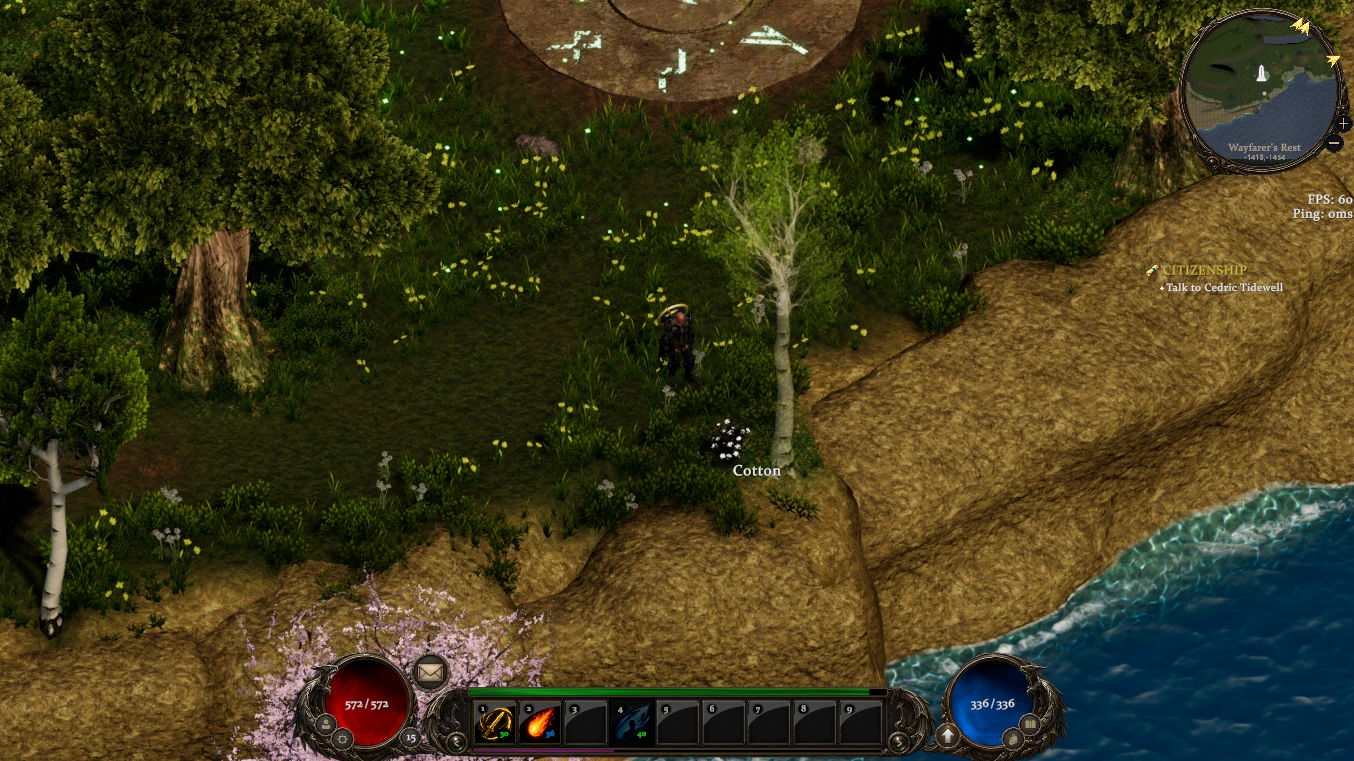
Less predictable positions shouldn’t mean searching at random. The latest southern Wayfarer’s Rest pass has been prepared with 27 replacement gatherable placements across Cotton, Stonecap, Briar Flower, Flax and Silverleaf, including Cotton at the farm. That work is currently in staging, alongside descriptions that explain the habitats and terrain worth searching.
For example, the new wording points towards sunny fields for Cotton and damp woodland or shaded stream banks for Silverleaf. It gives players a useful clue and gives us something concrete to check against the map. If the description sends you to a stream bank, finding the plant there should be more likely than finding the developer making excuses.
Placement and respawn behaviour are separate choices. This pass reviews where resources belong; it doesn’t by itself prove that every placement uses the new area controller. I’m keeping fixed gathering spots where predictable access is intentional, including the temporary farming areas while the dedicated farming system is still to come.
Giving gathering somewhere to go
Helrift’s direction is that every path leads deeper into conflict. Gathering and crafting are part of how you build towards PvP, and valuable resources should give you reasons to venture into places where other players become part of the risk.
That needs a sensible progression on the way there. Early equipment must have useful material routes in the places players are ready to explore. Crafting is one route into combat; dropped and traded equipment remain useful alternatives.
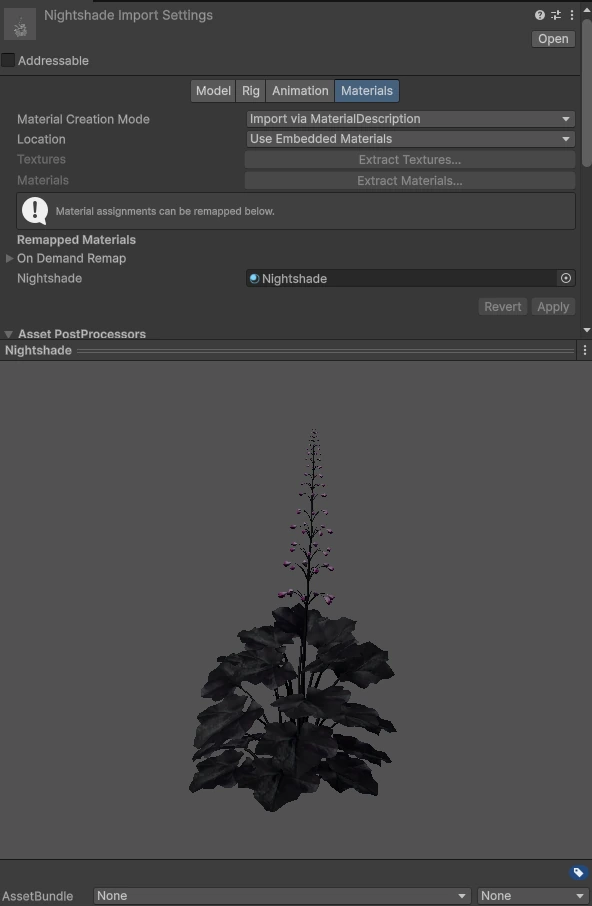
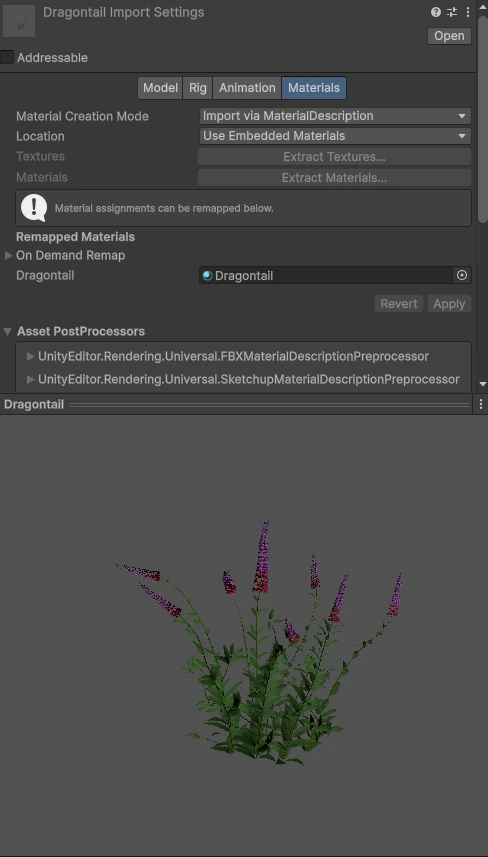
Nightshade and Dragon Tail belong to the approved higher-risk resource plan. The current balance pass checks their actual sources alongside tools, processing, stations and recipe alternatives. I’m checking the complete route rather than treating an item definition, or an old map-authoring note, as proof that a plant is either obtainable or still missing.
Tanning and profession rewards have also landed during this balance work. Ingredient conservation and extra output can change how much raw material a crafting route needs, especially when processing comes before the finished item. That is another reason to check the whole chain. Part 3 will get into those recipes and crafting choices; here, the question is whether the materials can be found in the right places.
The bands help check that connection between opportunity and risk. They aren’t a quality label pasted onto every plant. A safer alternative source can change a whole route, and a recipe doesn’t become sensible just because its ingredients sound suitably ominous.
A little of the Unity setup
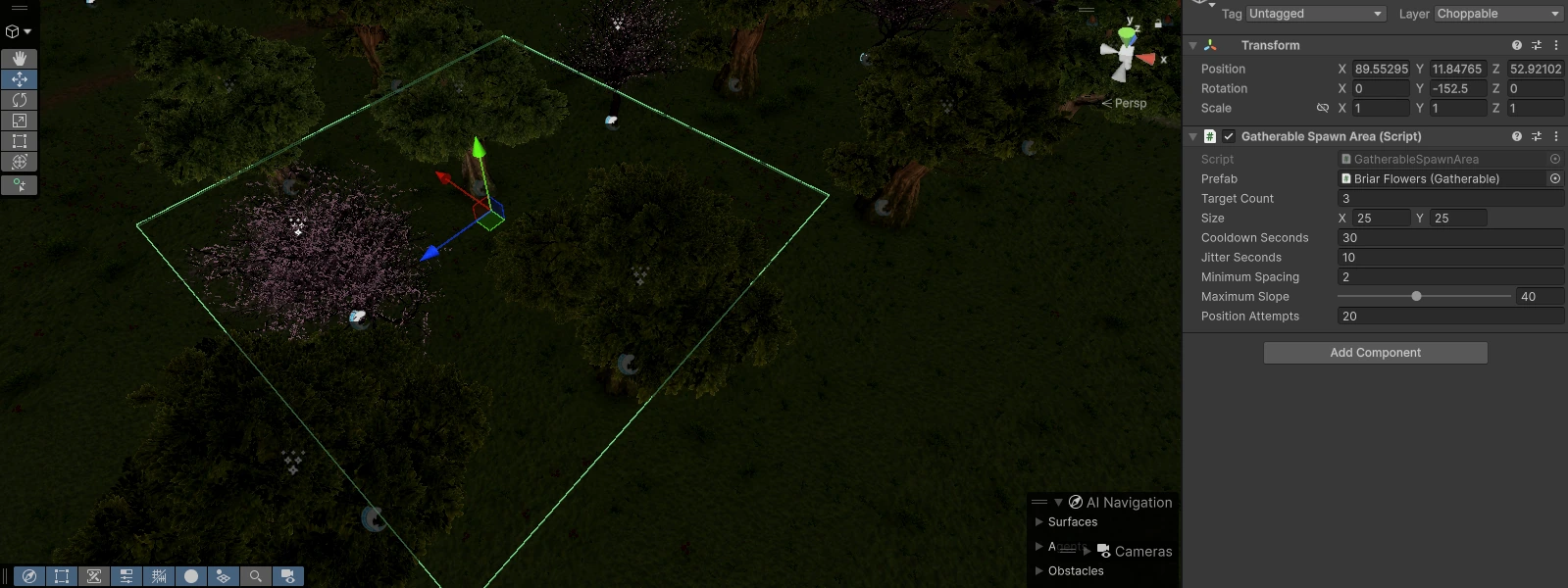
In Unity, I add a GatherableSpawnArea beneath a map chunk, assign its networked gatherable prefab, and set the area’s size in the Inspector. Selecting it draws a wire outline in the Scene view, so I can see where its nodes are allowed to appear.
Each area has a target number of active nodes, a cooldown and timing variation, and minimum spacing. The chunk’s GatherableAreaController adds a shared limit across the areas it manages. That limit covers its managed nodes, rather than every fixed gatherable in the scene. Random positions and resource availability are separate controls.
The server checks the ground, slope, chunk boundaries, configured blocking layers and spacing from other managed nodes before placing one. If it can’t find a suitable position within its attempt limit, it skips that attempt and tries again on a later tick. The nice part is shaping a resource region in the editor rather than placing every individual spawn point.
What still needs checking
The latest balance work is about checking the systems and routes already built: whether required materials are reachable, whether protected sources undermine intended contested inputs, and whether both factions have comparable opportunities. The remaining review also needs to account for processing and profession bonuses rather than reuse the old material-demand assumptions.
For gathering, the practical checks are that areas replenish correctly when several players use them, interruptions don’t award materials, and the places suggested by item descriptions match the authored world. Those are checks to complete, not evidence that the economy is already balanced or that the old playtest behaviour has disappeared.
I’m looking forward to seeing people explore these areas properly. Gathering should reward the player who is there making decisions, rather than the mouse having a busy afternoon on its own.
That’s the thread for this series: taking what happened in the playtest and making the systems work better together. Gathering follows the banding framework introduced in Part 1. Part 3 follows the same reasoning through recipes, processed materials and profession rewards.
If you’re building something similar and want to ask about the Unity setup, you can get in touch. And if you played the test, I’d like to hear how gathering felt from your side.